
Last Updated: October 26, 2026
Quick Summary
Laminate vs timber veneer for cabinet doors comes down to priorities: laminate offers affordability, moisture resistance, and minimal maintenance, whilst timber veneer provides authentic wood character and can be refinished, but demands more careful upkeep and costs more upfront.
- Laminate resists scratches, stains, and moisture better than veneer and requires only soap and water to clean.
- Timber veneer can be sanded and refinished to extend its life, whilst damaged laminate typically requires door replacement.
- Laminate costs less to produce and install, whilst veneer commands a premium because it uses real wood and requires skilled application.
- Veneer needs monthly conditioning and annual sealing to protect against moisture and humidity fluctuations.
- A hybrid approach works well: laminate for high-traffic and moisture-prone areas, veneer for display cabinets or lower-traffic sections.
Table of Contents
- Laminate vs Timber Veneer for Cabinet Doors: Quick Comparison
- Laminate vs Veneer Durability: Which Finish Lasts Longer
- Laminate vs Timber Veneer Cost: What to Budget
- Appearance and Aesthetics: Real Wood Feel vs Modern Finish
- How to Clean Laminate Cabinet Doors
- How to Care for Timber Veneer Cabinets
- Choosing the Right Finish for Your Kitchen Renovation
- Frequently Asked Questions
Laminate vs Timber Veneer for Cabinet Doors: Quick Comparison
When you're planning a kitchen or laundry renovation, the choice between laminate and timber veneer for cabinet doors shapes both how your space looks and how it performs over time. Both finishes have genuine strengths, and real weaknesses. The difference comes down to your priorities: budget, durability, aesthetics, and maintenance.
Laminate offers affordability and practicality. It resists moisture, scratches, and stains better than veneer. It's also easier to clean and requires minimal upkeep. The trade-off is that laminate doesn't feel like real wood, and once it's damaged, repair is difficult.
Timber veneer gives you authentic wood grain and warmth. It can be sanded and refinished if needed. The catch is cost, veneer typically runs higher than laminate, and it demands more careful maintenance. Moisture and humidity can cause veneer to lift or warp if not managed properly.
At East Coast Joinery Solutions, we work with both materials depending on what works best for each client's space, workflow, and budget. The right choice depends on your kitchen's environment, how heavily you use it, and what matters most to you visually.
Here's the direct comparison:
| Factor | Laminate | Timber Veneer |
|---|---|---|
| Cost | Lower upfront cost | Higher upfront cost |
| Durability | Highly scratch and stain resistant | Requires more careful handling |
| Moisture resistance | Excellent | Good if sealed; vulnerable if not |
| Appearance | Modern, uniform finish | Natural wood grain and warmth |
| Repairability | Difficult; often requires replacement | Can be sanded and refinished |
| Maintenance | Minimal; wipe clean | Regular sealing and conditioning |
| Best for | Busy kitchens, high moisture areas | Homes prioritising aesthetics and longevity |
Laminate vs Veneer Durability: Which Finish Lasts Longer
Laminate edges out timber veneer when durability is your main concern. It's engineered to resist scratches, heat, and moisture, the three things that damage kitchen cabinets most. Laminate won't warp if humidity spikes, and it won't absorb spills if wiped quickly. That resilience makes laminate the practical choice for families with young children or busy cooking routines.
Timber veneer is durable when properly maintained, but it's more vulnerable to environmental stress. Humidity fluctuations cause real wood to expand and contract, which can eventually cause veneer to lift at the edges or seams. If moisture penetrates the substrate, the veneer can separate or rot. This doesn't mean veneer is fragile, it means it needs attention.
The real difference in longevity comes down to use patterns. A laminate door in a heavily used kitchen might last 15-20 years without visible wear. A veneer door in the same kitchen might show signs of wear sooner if not maintained, but if sealed and cared for, can last just as long.
Laminate, once damaged, typically can't be repaired, you replace the door. Veneer can be sanded, stained, or resealed, which extends its life considerably. For homeowners who plan to stay in their home long-term and are willing to maintain their cabinetry, veneer often wins the durability argument.
Laminate vs Timber Veneer Cost: What to Budget
Cost is where the two materials diverge most sharply. Laminate is the affordable option, it costs less to produce, and the installation process is straightforward. Timber veneer commands a premium because it uses real wood slices, requires skilled application, and often involves additional finishing steps like sealing or staining.
The price difference isn't just material cost. Veneer demands more precision during installation, and mistakes are harder to hide. Laminate is more forgiving, misaligned seams are less noticeable, and surface imperfections blend in.
When planning your budget, remember that material cost is only part of the story. Consider maintenance costs over time. Laminate requires minimal upkeep, occasional cleaning is enough. Veneer may need periodic resealing, conditioning treatments, or professional refinishing. These aren't huge expenses, but they add up.
If budget is tight and you need cabinetry that won't demand ongoing attention, laminate makes financial sense. If you're investing in a longer-term renovation and want the option to refresh or refinish your doors later, veneer's higher upfront cost becomes more justifiable.
At East Coast Joinery Solutions, we provide clear written quotes that break down material, labour, and finishing costs before work begins. This transparency helps you understand exactly where your money goes and makes it easier to compare options fairly. How to Avoid Hidden Kitchen Renovation Costs covers budgeting strategies that prevent unexpected expenses during your project.
Appearance and Aesthetics: Real Wood Feel vs Modern Finish
This is where personal preference takes over. Laminate delivers a sleek, modern aesthetic. It comes in hundreds of colours and patterns, including designs that mimic wood grain. The finish is uniform and polished, it reads as contemporary and clean.
The downside is that laminate doesn't feel like wood. The surface is smooth and slightly plastic-like to the touch. Under close inspection, the printed pattern reveals itself as a print, not authentic grain.
Timber veneer offers genuine wood character. Real wood grain varies naturally, and the surface has tactile warmth.
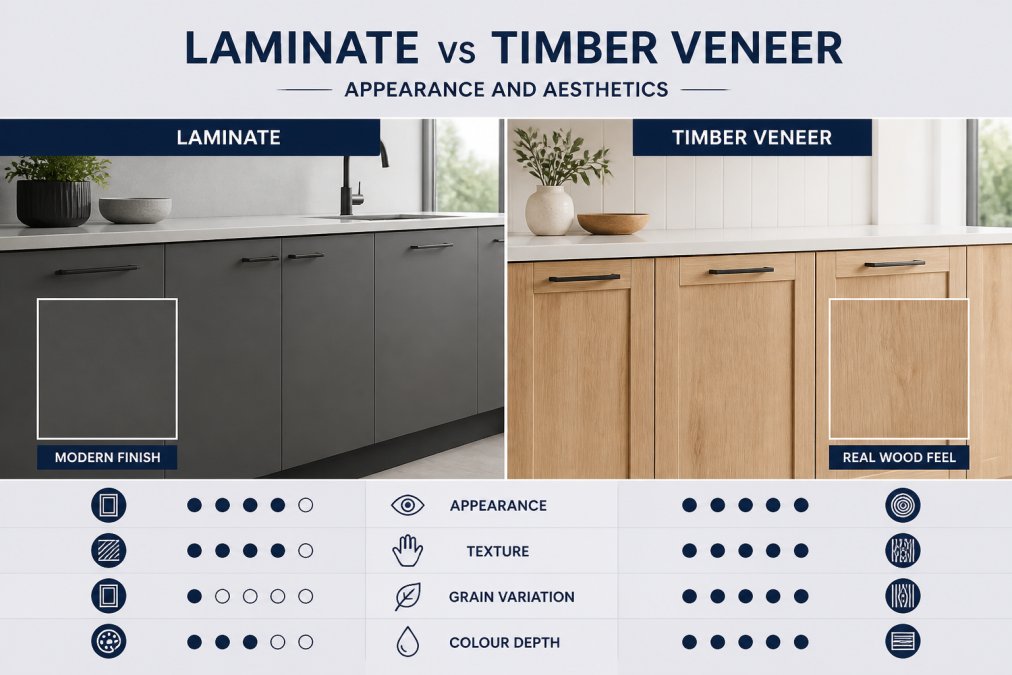
The feel matters too. Running your hand across a laminate door feels smooth and hard. Running your hand across a veneer door feels warmer and slightly textured. Over time, this tactile difference influences how much you enjoy your kitchen.
Veneer also has longevity in its aesthetics. If you tire of the colour or finish, you can sand and restain it. Laminate doesn't offer that flexibility, if you want a different look, you replace the doors.
How to Clean Laminate Cabinet Doors
Laminate is low-maintenance by design. Regular cleaning takes minutes and requires nothing more than mild soap and water.
Daily or weekly cleaning: Use a soft cloth or microfibre cloth with warm water and a few drops of washing-up liquid. Wipe the door surface gently, then dry immediately with a clean cloth. This removes dust, fingerprints, and light spills.
Stubborn marks or dried spills: Make a paste of bicarbonate of soda and water. Apply it to the stain, let it sit for 5 minutes, then gently rub with a soft cloth. Rinse with a damp cloth and dry. Avoid abrasive scrubbers or scouring pads, they scratch the laminate surface.
Grease buildup: Mix equal parts white vinegar and water in a spray bottle. Spray lightly onto the door, let it sit for 2 minutes, then wipe with a soft cloth. Vinegar cuts through grease without damaging the laminate finish.
What to avoid: Don't use harsh chemicals, bleach, or acetone-based cleaners, they can discolour or soften the laminate. Avoid prolonged exposure to standing water. Don't use abrasive sponges or steel wool. Keep heat sources away from laminate doors, excessive heat can cause the surface to warp or bubble.
The beauty of laminate is that this simple routine keeps it looking new for years. No special products, no conditioning, no sealing required.
How to Care for Timber Veneer Cabinets
Timber veneer needs more attention than laminate, but the care routine is straightforward and takes minimal time if done regularly.
Routine cleaning: Use a soft, dry cloth to dust the doors weekly. For light cleaning, dampen the cloth slightly with water and a drop of mild washing-up liquid.
Monthly conditioning: Every month or two, apply a timber conditioning oil or beeswax product designed for wood furniture. These products nourish the wood, maintain its colour, and provide a protective barrier against moisture.
Addressing spills: If you spill liquid on a veneer door, wipe it immediately. Don't let it sit. For sticky spills (honey, jam, sauces), dampen a cloth with warm water and a tiny amount of washing-up liquid.
Sealing (annual or as needed): Depending on your kitchen's humidity and use, consider resealing your veneer annually. A timber sealer protects against moisture penetration and UV fading.
What to avoid: Don't expose veneer to direct sunlight for extended periods, it can fade the colour. Avoid prolonged exposure to steam or humidity spikes. Don't place hot pots directly on veneer doors, use trivets or heat-resistant mats.
The time investment in veneer care is modest compared to the aesthetic and longevity benefits. Many homeowners find that a quick monthly conditioning routine keeps their veneer looking beautiful for decades.
Choosing the Right Finish for Your Kitchen Renovation
The decision between laminate and timber veneer comes down to three questions: What's your budget? How much maintenance are you willing to do? What aesthetic matters most to you?
If you're renovating a kitchen in a high-moisture area (near the sink, in a steamy cooking space), laminate's moisture resistance makes it the practical choice. If you're in a drier climate or can manage regular sealing, veneer becomes more viable.
If your kitchen is heavily used by a large family or you're time-poor, laminate's durability and minimal maintenance fit your life better. If you're planning to stay in your home long-term and enjoy hands-on care, veneer rewards that attention with warmth and the ability to refresh the finish later.
If you're drawn to modern, clean aesthetics, laminate aligns with that vision. If you want authentic wood character and are willing to invest in it, veneer delivers that.
Many homeowners find a hybrid approach works best, laminate for high-traffic areas and moisture-prone zones, veneer for display cabinets or lower-traffic sections. This balances budget, practicality, and aesthetics.
The best outcome happens when you work with someone who understands both materials, your kitchen's specific environment, and your actual daily routines. At East Coast Joinery Solutions, we help clients navigate this decision by looking at their space, their usage patterns, and their long-term vision.
Frequently Asked Questions
What is the difference between laminate and timber veneer cabinet doors?
Laminate is a synthetic material made from layers of plastic and resin bonded to a substrate, offering consistent colour and pattern. Timber veneer uses thin slices of real wood adhered to a plywood base, providing authentic wood grain and natural variation. Laminate mimics wood appearance but is entirely man-made, whilst veneer delivers genuine wood character. Both are applied to cabinet door surfaces, but veneer's real-wood composition gives it a distinct tactile and visual quality that laminate cannot fully replicate.
Are laminate or timber veneer cabinet doors more durable?
Laminate generally offers superior resistance to scratches, moisture, and staining due to its hard plastic surface. Timber veneer is more susceptible to scratches, water damage, and fading if not properly sealed and maintained. However, laminate can chip or peel if damaged, exposing the substrate underneath, whilst veneer can be refinished or repaired more easily. For high-traffic kitchens, laminate's durability advantage is significant. Veneer suits lower-traffic spaces or homes where refinishing is an acceptable maintenance option.
Which is cheaper, laminate or timber veneer for cabinet doors?
Laminate is typically the more affordable option due to its lower material and manufacturing costs. Timber veneer costs more because it uses real wood and requires skilled application. The price difference varies depending on the veneer species selected and laminate design. For budget-conscious renovations, laminate delivers cost savings without sacrificing appearance. Veneer represents a premium investment for homeowners prioritising authentic wood aesthetics and willing to spend more upfront.
How do you choose between laminate and timber veneer for kitchen cabinets?
Consider your kitchen's usage intensity: laminate suits busy families and high-moisture environments. Evaluate your aesthetic preference: laminate offers modern, consistent finishes, whilst veneer provides natural wood character. Factor in maintenance commitment: laminate requires minimal care, veneer needs regular sealing and careful cleaning. Budget is also key: laminate costs less initially, though both require professional installation for best results. Discuss your priorities with a joinery specialist who can assess your specific kitchen layout, workflow, and long-term durability needs.
The choice between laminate and timber veneer shapes how your kitchen functions and feels for years to come. Both materials have genuine merit, the question is which one suits your priorities. If you're ready to explore custom cabinetry options for your renovation, request a free quote and discuss which finish makes sense for your space, your budget, and your lifestyle.
