
Table of Contents
- Modern Cabinetry Design Trends 2026: What's Actually Changing
- Kitchen Cabinet Trends 2026: Layouts That Work Harder
- Kitchen Cabinet Colours 2026: Warm Neutrals and Deep Tones
- Kitchen Cabinet Materials and Finishes: What Lasts in a Working Kitchen
- Custom Kitchen Cabinets vs Flat-Pack: Getting the Layout Right
- Trends Worth Skipping and Where to Spend Instead
- Conclusion
- Frequently Asked Questions
Last Updated: 12 October 2026
Modern Cabinetry Design Trends 2026: What's Actually Changing
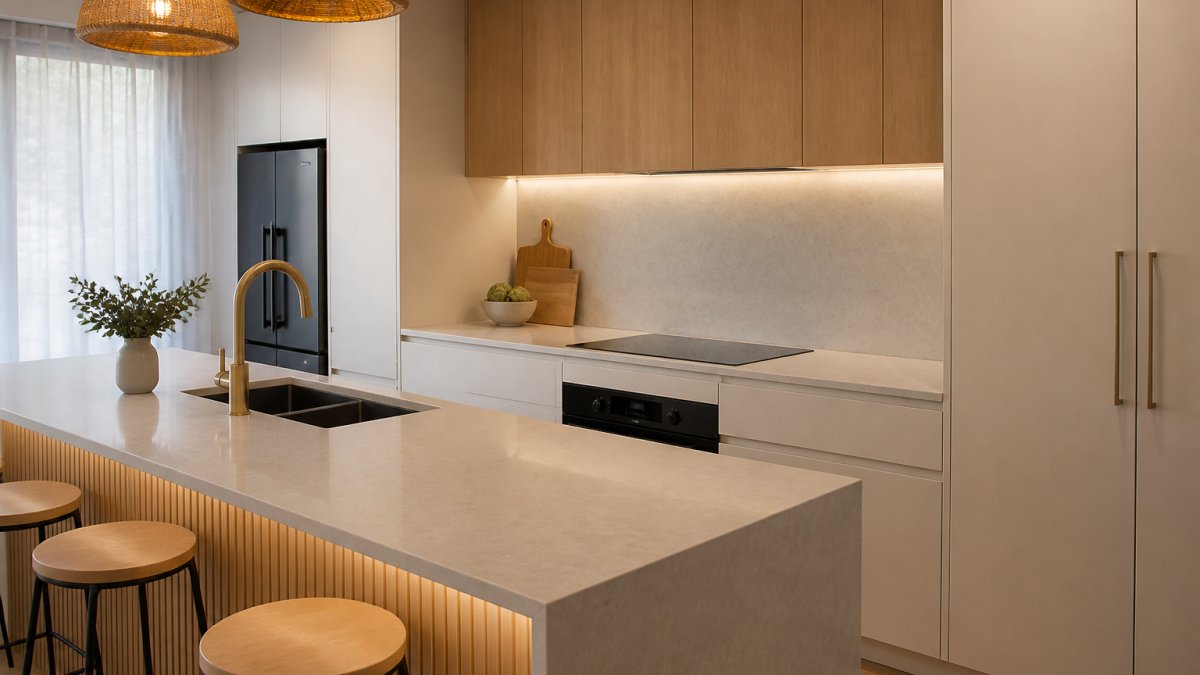
Walk into a newly finished kitchen in Burpengary or Morayfield and you'll notice something different from the glossy showroom displays of a few years ago. Modern cabinetry design trends in 2026 have shifted away from statement pieces and toward cabinetry that simply works harder. The biggest change isn't a colour or a finish. It's a mindset: homeowners now ask "where does the air fryer live?" before they ask about door profiles.
Three forces are driving this. First, kitchens are smaller relative to what gets stored in them. Second, appliance counts keep climbing. Third, renovators have learned the hard way that a beautiful kitchen with the wrong layout is an expensive mistake.
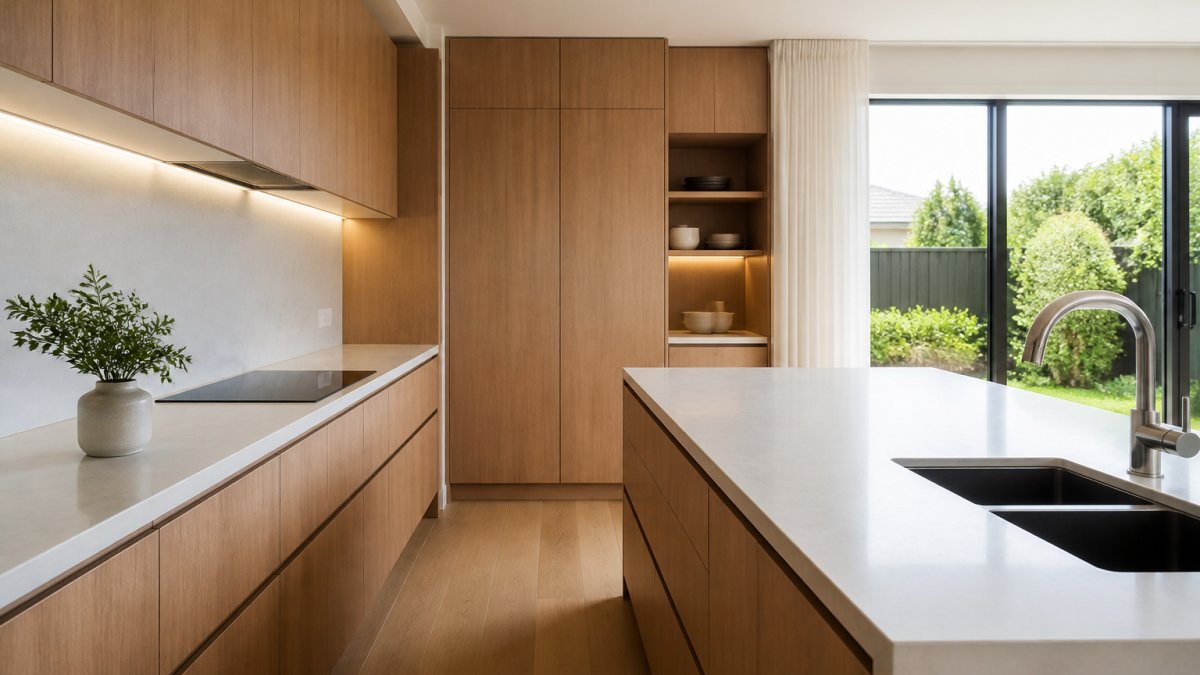
Below, we break down the cabinetry design trends worth your money in 2026, and the ones you can safely ignore.
Kitchen Cabinet Trends 2026: Layouts That Work Harder
The defining kitchen cabinet trends in 2026 are about function hiding in plain sight. Storage is being designed around specific appliances and workflows rather than generic shelf space.
Hidden Storage and Appliance Garages
An appliance garage is a dedicated cabinet section, usually with a roller or lift-up door, that houses the kettle, toaster, and coffee machine behind a closed front. The benchtop stays clear, and the appliances stay plugged in.
A common mistake is sizing the garage before buying the appliances. Measure the tallest item with its lid open, then add clearance. If the garage is too shallow, the doors won't close and the whole point is lost.
Handleless and Integrated Profiles
Handleless doors use a routed finger pull or a shadow-line profile instead of a knob. The look is clean, and there's nothing to catch a hip on in a tight galley.
The trade-off is real. Finger-pull routes collect crumbs and need wiping more often than a flat door. For busy family kitchens, a slim integrated handle often beats a pure push-to-open system, which relies on springs that wear out.
Kitchen Cabinet Colours 2026: Warm Neutrals and Deep Tones
The kitchen cabinet colours 2026 palette has moved decisively away from cool grey. Warm neutrals, think oatmeal, mushroom, and soft sand, now dominate, with deep forest green and charcoal reserved for island fronts and tall cabinetry.
Why the shift? Cool greys read as cold under downlights, and renovators noticed. Warm tones sit better with timber floors and stone benchtops, and they hide everyday marks more forgivingly than gloss white.
Colour Direction | Best Applied To | Watch Out For |
|---|---|---|
Warm oatmeal and sand | Full run of base and wall cabinets | Can look flat without a contrasting benchtop |
Deep green or charcoal | Island fronts, tall pantry doors | Shows dust on horizontal surfaces |
Two-tone (light uppers, dark lowers) | Galley and L-shaped kitchens | Needs a clear dividing line, or it looks accidental |
Two-tone schemes remain the safest way to add depth without committing the whole kitchen to a bold colour. Keep the darker tone below eye level and the room feels taller.
Kitchen Cabinet Materials and Finishes: What Lasts in a Working Kitchen
Kitchen cabinet materials and finishes in 2026 favour durability over novelty. A common and durable combination is a moisture-resistant carcass with a thermally fused laminate or low-sheen polyurethane door.
- Thermally fused laminate (TFL): tough, easy to wipe, and the most cost-effective for high-use doors
- Low-sheen polyurethane: smoother finish, repairable in patches, best for painted-look kitchens
- Timber veneer: warm and distinctive, but needs protection near sinks and dishwashers
- Solid timber: beautiful for open shelving and island ends, less practical for full door runs
High-gloss finishes have quietly fallen out of favour. They show every fingerprint, and in a kitchen with kids, that's a daily chore.
Hardware That Survives Daily Use
Hardware is where cheap cabinetry gives itself away. Soft-close hinges and full-extension runners with a decent load rating matter more than the door colour. A common mistake is accepting unbranded runners to save a few dollars, then replacing them within two years.
Custom Kitchen Cabinets vs Flat-Pack: Getting the Layout Right
The custom kitchen cabinets vs flat-pack decision comes down to one question: does your space match a standard size? Flat-pack works when the room is square and the appliance positions are conventional. Custom joinery wins the moment a wall is out of square, a window sits low, or you want storage shaped around how you actually cook.
Flat-pack isn't automatically the cheaper long-term option. If you pay a tradesperson to assemble and modify modules on site, the gap narrows quickly.
This is where a measured design conversation matters. A measured design conversation matters, walking through your appliance list and daily workflow before drawing a single cabinet, so the layout is settled before anything is cut.
Trends Worth Skipping and Where to Spend Instead
Not every trend earns its place. Open shelving looks excellent in photos and collects grease in real kitchens. Push-to-open drawers on a full pantry are awkward when your hands are full. Ultra-matt black doors show every smear.
Spend instead on the parts you touch daily:
- Drawer runners and hinges with a recognised load rating
- A properly sized appliance garage with internal power
- Soft-close mechanisms throughout, not just on the doors visitors see
- A carcass rated for moisture in laundry and kitchen applications
If you're sourcing your own cabinetry and just need it installed, that's a service we handle too. We install both our own custom work and cabinetry supplied by builders and cabinetmaking shops, with a clear written scope and pricing agreed before work starts.
Conclusion
The real challenge with cabinetry in 2026 isn't picking a colour, it's getting a layout that still works five years from now. Trends fade, but a drawer that opens smoothly and a bench you can actually use don't.
Frequently Asked Questions
What are the biggest kitchen cabinet trends for 2026?
The strongest shifts are toward handleless profiles, integrated appliance storage, and warm neutral colours instead of the cool greys that dominated the early 2020s. Timber-look finishes are holding their place, particularly in veneer and textured laminate. The bigger change is functional: layouts are being designed around how a household actually cooks and stores, rather than around a fixed showroom template. That means more full-height cabinetry, deeper drawers instead of cupboards, and dedicated zones for appliances.
What colours are on trend for kitchen cabinet colours 2026?
Warm neutrals lead the way: soft stone, mushroom, oatmeal, and muted sage. Deep tones such as forest green, navy, and charcoal are still popular for island cabinetry or as a contrast against lighter wall cabinets. Two-tone schemes remain common because they break up large runs of cabinetry and add visual depth. If you are planning to sell within a few years, a warmer neutral base with a bolder island is the safer combination than an all-dark kitchen.
Are custom kitchen cabinets worth the extra cost compared with flat-pack?
It depends on how awkward your space is and how long you plan to stay. Custom cabinetry is built to your room's actual dimensions, so you avoid filler panels, wasted corners, and drawers that clash with door swings. Flat-pack suits standard rectangular rooms on a tight budget. For renovation projects in older homes, or where the kitchen is the main living hub, custom joinery usually delivers a better layout and a longer service life. Pricing depends on size, materials, and hardware, so request a written quote before committing.
Which cabinet finishes are easiest to maintain?
Low-sheen and matt finishes hide fingerprints better than high-gloss, which shows every smudge. Textured laminate and two-pack polyurethane are both straightforward to wipe down with a damp cloth and mild detergent. Timber veneer needs a little more care and should be kept away from standing water. Whatever finish you choose, ask for the care instructions in writing and keep abrasive cleaners away from the surface, since they dull the coating over time.
If your renovation needs cabinetry designed around how you actually live, East Coast Joinery Solutions can help. We provide practical layouts built around your storage needs, durable finishes with quality hardware, and accurate, tidy installation that respects an occupied home. You deal directly with the owner, Harry, and receive clear written scope and pricing before work begins. Get started with East Coast Joinery Solutions and request a free quote for cabinetry that lasts.